Written By: Risa Toth, Business Development Manager, Excel Scientific
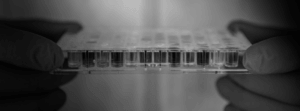
Bubbles Are Not Always Just Cosmetic
Many lab users consider bubbles under a sealing film to be a minor aesthetic issue. However, in sensitive workflows especially qPCR, ELISA, luminescence, and fluorescence assays bubbles can interfere with detection, promote uneven evaporation, or distort sample uniformity.
Why Bubbles Form Under Sealing Films
- Uneven pressure during application
If the center is applied first without smoothing outward, trapped air pockets remain.
- Adhesive stiffness or film memory
Lower-grade films tend to curl back to their manufactured shape, resisting flat application.
- Dust or particulates on the plate rim
Even microscopic debris prevents adhesion and traps air.
- Plate well geometry
Certain deep-well or skirted plates have raised edges that complicate uniform sealing.
- Temperature differences
Applying films to cold plates can cause expansion and bubble formation as the plate warms.
When Bubbles Actually Matter
Bubbles that DO NOT typically affect workflows
- Small edge bubbles away from wells
- Bubbles located on the outer adhesive border
Bubbles that DO affect workflows
- Bubbles that sit over active wells
- Large central bubbles that disrupt optical read distance
- Bubbles that allow evaporation or contamination
- Bubbles that cause non-uniform pressure over assay wells
How to Prevent Bubbles
- Apply seals from one edge and slowly roll across
- Use a roller or paddle to eliminate trapped air
- Ensure plates are clean and dry
- Use a film with high flexibility and low curl
- Store Film flat
Where Excel Scientific Fits In
Excel films are manufactured with low-curl materials, medical-grade adhesives, and precision cutting to ensure smooth application and minimal bubble formation.
Recommended Excel Scientific Films
- ThinSeal™ — ultrathin film minimizes risk of bubble formation during optical assays
- SealPlate™ — balanced flexibility and adhesion
- ZONE-FREE™ — ideal for preventing optical distortion in colorimetric assays
- X-Pierce™ — maintains flatness and integrity even after automated piercing